How to Choose the Right Window Tint for Your Car
Choosing window tint means balancing your goal (heat, privacy, UV), your state's legal VLT limit, film type, and a budget between $80 and $800.
Quick Answer: Start by checking your state's legal VLT limit, then decide whether you want heat rejection (ceramic), privacy (any dark film), or UV protection (even clear films work). Budget $150-$400 for a solid carbon or entry-level ceramic job on a sedan.
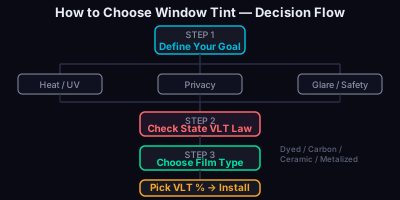
Most people walk into a tint shop with a vague idea, "I want it darker", and walk out with something that either fails inspection or doesn't do what they actually wanted. A little structure before you go saves a lot of money and frustration.
Here's a step-by-step decision process that takes about 15 minutes and covers everything that actually matters.
Step 1: Define Your Primary Goal
Different goals lead to different film choices. Figure out which of these matters most to you:
Heat rejection: You live somewhere hot and your car turns into an oven in summer. You need a film with high Total Solar Energy Rejection (TSER), typically 40-70% for quality ceramic films. Dark color alone doesn't mean good heat rejection; a light ceramic film blocks more heat than a dark dyed film.
Privacy: You transport valuables, park in high-theft areas, or just don't want strangers looking in. Any dark film achieves this. A 20-35% VLT film on rear windows gives strong privacy. Front windows are limited by law in most states, so privacy up front is harder to get legally.
UV protection: You're worried about skin damage during long drives, or you want to protect leather seats and dashboards from fading. Almost all window tint films block 99% of UV-A and UV-B rays, even fairly light films. You don't need to go dark for UV protection. A clear film rated for UV rejection is an option if your state limits visible tint.
Glare reduction: Long commutes into the sun, lots of highway driving. A medium VLT (35-50%) film on front side windows makes a noticeable difference. Don't go too dark on front windows, it reduces glare but also reduces overall visibility at night.
Most people actually want 2-3 of these, which is fine. Just rank them so you can make trade-offs.
Step 2: Check Your State Law First
This is non-negotiable. Every state has a VLT minimum for each window position, and the penalty for ignoring it is paying to remove the film you just bought, plus a fine.
The catch most people miss: your film's labeled VLT percentage isn't what gets measured at inspection. The inspector measures the combined VLT of the film plus your factory glass together.
The formula is: Combined VLT = (Film VLT × Factory Glass VLT) ÷ 100
Say your state requires 35% minimum on front windows. Your factory glass is 75% VLT (typical for most sedans). You buy a 35% film. Your combined reading will be:
(35 × 75) ÷ 100 = 26.25%
That's a failed inspection. You'd need a film that, combined with your 75% factory glass, produces at least 35%. Working backwards: Film VLT = (35 ÷ 75) × 100 = 46.7%. So you'd need a film labeled ~47% or lighter.
Use the window tint VLT calculator to run these numbers for your specific car and state before you buy anything. You plug in your target combined VLT and your factory glass VLT, and it tells you what film percentage to ask for.
For a full state-by-state breakdown of legal limits, see our window tint laws guide.
Step 3: Choose Your Film Type
There are four main film types, each with different performance, longevity, and price:
Dyed film is the entry-level option. It's a layer of dyed polyester that absorbs some heat and blocks UV. Heat rejection is modest, around 25-35% TSER. It fades to a purple-brown color within 2-5 years. Cost for a full car: $80-$250. Good if you're on a tight budget or tinting a car you plan to sell soon.
Metalized film has tiny metallic particles that reflect heat rather than absorb it, better heat rejection than dyed (35-45% TSER). The downside: it interferes with GPS, radio, and cell signal. Also banned in some states due to reflectivity limits. Cost: $100-$350 full car. Mostly been replaced by carbon and ceramic.
Carbon film blocks infrared heat without metal particles, so no signal issues. Heat rejection of 40-50% TSER. It holds its color well, no purple fade. Lifespan of 7-12 years with proper care. Cost: $150-$400 full car. This is the sweet spot for most buyers who don't want to go full ceramic.
Ceramic film is the premium option. Nano-ceramic particles block 50-70% of solar energy without affecting signals. Best optical clarity, best longevity (10+ years), and manufacturer warranties are common. Cost: $300-$800 full car depending on brand and vehicle size. Worth it for a car you plan to keep.
Read our deep-dive comparison of ceramic vs. dyed window tint if you're on the fence about whether the premium is worth it.
Step 4: Pick Your VLT Percentage
Once you know your legal limits and what film type you want, the VLT choice is mostly about aesthetics and function.
50% VLT: Nearly invisible from outside. Blocks UV and a modest amount of heat. Won't raise eyebrows or fail inspections in any state. Good for front windows when law requires 35%+ and you want some protection without drama.
35% VLT: The most popular choice. Noticeably darker from outside, meaningfully reduces glare inside, good privacy without being "limo dark." Legal in most states for front side windows (check yours first).
20% VLT: Dark and private. Good for rear windows on SUVs and sedans in states where rear tint is unrestricted or limits are 20%+. Not legal for front windows in most states.
5% VLT (limo tint): Almost opaque from outside. Almost always restricted to rear windows only. Creates visibility issues at night even in the back seats.
For front windows in California, New York, or other strict states, 70% or lighter films are your only legal option. A high-quality ceramic at 70% still blocks UV and some heat, it just looks nearly stock.
Step 5: Budget Realistically
Here's what you're actually looking at:
- Dyed, full car sedan: $80-$250
- Carbon, full car sedan: $150-$400
- Ceramic, full car sedan: $300-$800
- Add 20-30% for SUVs and trucks (more glass area)
- Front windows only: $60-$200 depending on film type
The real cost breakdown, the questions to ask installers, and red flags to watch for are all covered in our window tint cost breakdown guide. Don't let a shop quote you "ceramic" without telling you the brand and model, that word gets used loosely.
Questions to Ask Your Installer
Before you hand over any money, get answers to these:
1. What specific film brand and model are you installing? (Not just "ceramic", ask for the product name)
2. What's the warranty and who honors it, the shop or the manufacturer?
3. What combined VLT will this produce on my car's factory glass?
4. Do you test the tint after install with a meter?
5. How long should I wait before rolling windows down?
A good installer answers all five without hesitation. Vague answers on the film brand or warranty are signs to keep looking.
One More Thing: The Calculator Does the Hard Part
The most error-prone step in this whole process is the VLT math. People consistently confuse film VLT with combined window VLT, and it costs them inspections, fines, and re-installs.
Before you finalize anything, run your numbers through our tint VLT tool. Input your factory glass VLT (your car's owner manual or dealer can tell you this, or your installer can meter it), your target film VLT, and it gives you the combined reading. Takes 30 seconds.
The whole decision process, goal, law, film type, VLT, budget, takes maybe 20 minutes with the right tools. That's a lot less painful than discovering at inspection that you need to redo $400 of work.