How Much Does Window Tinting Cost? 2026 Price Guide
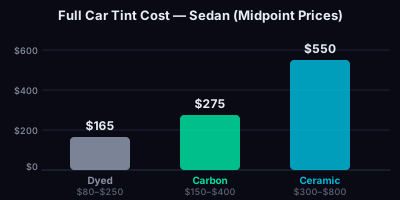
Full car window tinting costs $80-$250 for dyed film, $150-$400 for carbon, and $300-$800 for ceramic. Vehicle size, installer experience, and film brand all affect the final number.
Quick Answer: Expect to pay $150-$400 for a quality carbon tint job on a standard sedan, or $300-$800 for ceramic. SUVs and trucks run 20-40% more due to additional glass area. Dyed film is cheaper up front at $80-$250 but will need replacement within 3-5 years.
The range of prices you'll encounter when calling tint shops is genuinely confusing. One shop quotes $199 for "full ceramic," another quotes $650 for the same car. Both are real quotes. Here's what's actually driving the difference and how to evaluate whether you're getting a fair deal.
Price Ranges by Film Type
These are real-world ranges for a standard 4-door sedan with 5 windows (excluding windshield). All-in, including labor:
Dyed film: $80-$250
Entry-level product. Absorbs solar energy, provides UV blocking, gives you darker windows. Heat rejection is limited (25-35% TSER). Will fade within 2-5 years. Makes sense if you're on a strict budget or tinting a car you'll sell soon.
Metalized film: $100-$300
Mostly phased out of serious shops because it interferes with GPS, Bluetooth, and cell signal in modern cars. If a shop is pushing this as their "upgrade" option, that's a sign they haven't updated their product lineup recently.
Carbon film: $150-$400
The value sweet spot for most buyers. Real heat rejection (40-50% TSER), no signal interference, no fading. Carbon should be your minimum target if you're keeping the car more than 2 years.
Ceramic film: $300-$800
Best heat rejection (50-70% TSER), clearest optics, longest lifespan (10+ years), and typically the best warranties. The wide range is due to brand differences, budget ceramic from an unknown brand is not equivalent to premium ceramic from Llumar, 3M, or XPEL.
Price by Vehicle Size
Glass area is a direct driver of material and labor cost. A compact 2-door has dramatically less glass than a full-size SUV:
| Vehicle Type | Dyed | Carbon | Ceramic |
|---|---|---|---|
| Compact sedan (2-door) | $80-$180 | $130-$300 | $250-$550 |
| Standard sedan (4-door) | $100-$250 | $150-$400 | $300-$800 |
| Crossover / mid-size SUV | $150-$350 | $200-$500 | $400-$900 |
| Full-size SUV / truck | $180-$400 | $250-$600 | $500-$1,100 |
| Minivan | $200-$400 | $250-$550 | $450-$1,000 |
Ranges reflect national pricing as of 2026. Coastal metro areas (LA, NYC, Miami) tend to run 15-25% higher.
What the Quote Actually Includes
Before you compare prices, confirm what's in each quote:
Film cost: The material itself. Film runs $2-$20 per square foot depending on type and brand. A sedan has roughly 15-20 square feet of tintable glass.
Labor: Cutting, fitting, application, and cleanup. Labor is where skill differences show up. A rushed job at $60/hour by a novice looks completely different from a careful job by an experienced tech.
Removal of existing tint: If there's old tint on the car, most shops charge $50-$150 to remove it professionally. Some will include this in the quote; others add it on. Ask explicitly.
Window cleaning: Should be included. A proper tint job starts with spotless glass. If a shop doesn't mention glass prep, that's worth asking about.
Warranty: Better film and better shops include manufacturer-backed warranties. Cheap dyed film might come with a 1-year shop warranty (meaningless if the shop closes). Quality ceramic comes with 10-year to lifetime manufacturer warranties.
Factors That Move the Price
Several variables shift cost independent of film type:
Number of windows: Front-windows-only jobs run $60-$200 depending on film and car. This is the cheapest option if your state restricts front windows anyway and you want protection without tinting rear glass.
Installer reputation and location: A top-rated shop in an expensive city charges more than a strip-mall shop in a small town. The premium is often worth it, a bubbled or peeling tint job costs more to remove and redo than it would have to just do right.
Film brand: "Ceramic" is a category, not a brand. A shop using off-brand ceramic at $3/sqft is not comparable to a shop using Llumar FormulaOne at $12/sqft. Ask for the specific brand and model.
Vehicle complexity: Cars with curved rear windshields, defroster grids, or unusually shaped glass panels take longer and are harder to do cleanly. Shops charge more for complex geometry.
Partial jobs: Tinting only the rear windows (a common choice in strict states like California or New York) costs roughly 40-60% of a full car job.
Red Flags for Cheap Installs
Not all low quotes are a bargain. Here's what to watch for:
"Ceramic" with no brand name: Every reputable ceramic film has a brand and model. If the quote just says "ceramic," push for specifics. Generic unlabeled ceramic is often carbon or low-grade hybrid film being sold under a premium label.
No warranty on labor or materials: Quality shops stand behind their work. A shop that won't commit to fixing bubbles or peeling within the first year is telling you something.
No visible portfolio or reviews: Ask to see photos of recent jobs. Clean edges, no bubbles, consistent darkness across the window, these are the signs of a good install. A shop that can't show you examples is a risk.
Quote that seems impossibly low: A "full ceramic" job on an SUV for $199 either isn't using real ceramic film or is cutting corners on preparation and labor. The math doesn't work at real material costs.
Unwillingness to discuss combined VLT: A good installer knows your state's tint law and will tell you what combined VLT their suggested film will produce on your specific car. If they just quote you "35% film" without checking your factory glass VLT, they're either uninformed or hoping you don't ask.
DIY: What It Actually Costs
Pre-cut film kits for specific vehicles run $30-$100 online. You'd need an application kit (squeegee, heat gun, spray bottle) for another $20-$40. Total material outlay: $50-$140.
What you're trading for that saving: time (3-8 hours for a first attempt), the real possibility of needing to redo it (film isn't infinitely reusable), and typically a worse result on curved glass. The DIY vs. professional tinting comparison covers this in detail, including the honest failure modes.
For front windows and anything curved, pay a pro. For flat rear panels on a car you're not precious about, DIY is reasonable.
How to Get an Accurate Quote
Call 3-4 shops with these specifics:
1. Your car's year, make, and model
2. How many windows you want tinted
3. The film type you want (be specific: "carbon" or "ceramic" with a brand preference)
4. Your state's legal VLT requirement for each window position
A shop that can quote you accurately over the phone without needing to see the car has enough experience to know the work involved. A shop that refuses to give any number without an in-person visit for a standard sedan may be using that as an upsell opportunity.
Before any install, use our window tint cost and VLT calculator to verify that the film VLT you're buying will produce a legal combined VLT on your specific factory glass. The most expensive mistake in tinting isn't overpaying, it's paying for an install that fails inspection and having to do it twice.
For the broader question of which film type is right for your situation, the ceramic vs. dyed comparison breaks down the performance differences in detail. And for information about our approach to quality and accuracy, visit our about page.