8 Window Tinting Mistakes That Ruin the Result
The costliest tinting mistakes: buying illegal film, skipping the combined VLT calculation, rolling down windows too early, and choosing dyed film that fades purple within 3 years.
Quick Answer: The most expensive tinting mistake is installing illegal film, you'll pay to remove it plus a fine. The most common mistake is confusing film VLT with combined window VLT: a 20% film on 75% factory glass gives you 15% at the window, not 20%.
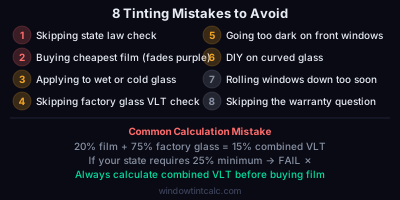
Most tinting problems are avoidable. The same mistakes show up over and over, in forum posts, in shop horror stories, in complaints from people who just spent $400 and immediately have to take it off. Here's the complete list of what goes wrong and how to sidestep each one.
Mistake 1: Not Checking State Law First
This is the costliest mistake on the list because the consequences extend beyond the immediate install.
Real scenario: A driver in California gets quoted "20% tint all around" by a shop and says yes without checking. California requires 70% VLT on front side windows. At the next smog check, the tint fails. He pays $75 to have the front windows stripped, $200 to re-tint with a legal clear film, plus the $180 fine from the officer who pulled him over the week before. Total extra cost: $455. The original front window tint job cost $120.
State law specifies the minimum combined VLT at each window position. That combined number is what a tintmeter reads, and it's what gets you cited.
Front windows get the most scrutiny because officers measure them through the rolled-down window frame. Rear windows get less enforcement attention but still matter for inspection in many states.
Check your state's rules before calling any shop. Our window tint laws by state guide covers front side, rear side, and rear windshield minimums for major states with 2026 rules.
Mistake 2: Buying the Cheapest Film (It Fades Purple)
Dyed film is cheap. It's also the only film type that visibly degrades in a way that's obvious to everyone who looks at your car.
Dyed film fades because the organic dyes absorb UV radiation and chemically break down over time. The black color doesn't persist evenly, the blue and green components fade faster than the red, leaving a brownish-purple color. It starts at the edges and areas of highest UV exposure first.
The timeline depends on climate and parking conditions, but in high-UV environments (Phoenix, Miami, Los Angeles):
- Year 1: Still looks normal
- Year 2: Subtle shift, maybe noticeable in direct sun
- Year 3: Clearly purple-brown, especially at the top edges near the roofline and around defrosters
Carbon and ceramic film don't have this problem. Carbon uses non-organic particles. Ceramic uses non-reactive nano-particles. Neither type fades.
If you're buying film that's supposed to last, spend the extra $80-$200 for carbon as a minimum. Dyed film that needs to be replaced in 3-4 years ends up costing more over time.
Mistake 3: Applying to Wet or Cold Glass (DIY Problem)
Window film adhesion depends on two things: a clean, dry surface and adequate temperature for the adhesive to cure.
Cold glass: Below about 45°F, the window film adhesive doesn't bond properly. The film goes on, looks okay initially, but develops lifting edges and bubbles within weeks as the adhesive never fully set. Most professional shops won't install in temperatures under 50°F outdoors, or they keep their bays climate-controlled.
Wet or contaminated glass: Any moisture, oil from fingerprints, dust, or road film between the glass and the adhesive creates a permanent defect, a bubble that won't disappear because it's not air but contamination. Proper prep involves razor scraping the glass, cleaning with ammonia-free solution, and immediately installing the film in a dust-controlled space.
DIY installers underestimate prep time. The prep often takes longer than the application, and skipping it guarantees problems. If you're doing it yourself, budget 30-45 minutes for glass prep on each window.
Mistake 4: Skipping the Factory Glass VLT Check
This is the math mistake that creates legal violations out of seemingly legal choices.
Here's how it plays out: a buyer in Nevada sees the 35% front window minimum on a state tint law site and buys "35% film." They get it installed. A month later, an officer runs a tintmeter and gets 26%. They get a citation.
The math: 35% film × 75% factory glass ÷ 100 = 26.25% combined. The film is 35%. The window measured 26%.
The factory glass VLT is the variable most buyers never think to ask about. It's typically 70-80% on side windows, but it varies by manufacturer and model. Some older vehicles have slightly different factory glass. Some vehicles (particularly certain European models) have factory glass that reads 65%.
Before any install, ask your installer to meter your factory glass. It takes 30 seconds on an untinted window. Then run the combined VLT calculation to confirm you'll be legal.
The window tint calculator does this directly, enter your film VLT and factory glass VLT and get the combined number that the inspector will see.
Mistake 5: Going Too Dark on Front Windows
Front windows are where you look while driving. Going very dark on front side windows creates real nighttime visibility issues, not dramatically unsafe, but measurably worse.
The vision problem scales with darkness. At 35% VLT on front windows, most drivers notice no meaningful nighttime visibility change. At 20% VLT, it's noticeable, oncoming headlights look dimmer through the window than they would without tint. At 5% VLT, nighttime visibility through the side windows is genuinely compromised.
Beyond the visibility issue: front windows are where law enforcement first checks tint. A very dark front window is a near-guarantee of being pulled over in any state with a front window minimum, even if you'd theoretically pass inspection.
The practical guidance: front side windows at 35% VLT (where legal) is the sweet spot. You get privacy and glare reduction without visibility trade-offs. Anything darker on front windows should be avoided regardless of what the law technically allows.
For states like California and New York with 70% minimum requirements, the choice is made for you, go with the lightest legal tint and focus on film quality for UV and heat protection.
Mistake 6: DIY on Curved Glass
Curved glass is where amateur tint jobs visibly fail. The issue is physics: a flat film sheet can't naturally conform to a curved surface without either stretching or forming creases.
Professional installers handle this through heat forming, using a heat gun on the exterior of the car to shrink the film to the window's curve before installation. Done properly, the film conforms perfectly and lies flat. Done improperly (or skipped entirely), you get "tunneling", raised ridges parallel to the window edges where the film didn't lay flat.
Tunneling is one of the most visible tint defects. It's obvious from outside the car and from inside. It also affects optical clarity, you're looking through a ridge that distorts light slightly.
Rear windshields are the most common DIY failure point. They're highly curved on most modern cars, they have defroster grids that complicate application, and they're one of the most visible windows on the car. Unless you have specific experience with rear windshield installation, pay a pro for this one.
For a full rundown on when DIY is and isn't reasonable, the DIY vs. professional tinting comparison covers failure modes in detail.
Mistake 7: Not Waiting 3-5 Days Before Rolling Windows Down
Fresh tint looks perfect when you leave the shop. Then you roll a window down on the drive home and peel the edge of the film away from the seal. Now you have a lifted edge that won't re-adhere cleanly and will continue to peel.
The film adhesive needs time to fully cure. During curing, the residual water between the film and glass slowly evaporates through the film. The window may look slightly hazy or have small bubbles during this period, this is normal and temporary.
The curing window where you absolutely shouldn't roll windows down:
- Summer, warm climate: 3-5 days
- Spring/fall, moderate climate: 5-7 days
- Winter, cold climate: 10-14 days minimum, potentially longer
Your installer should tell you the specific wait time for your film and climate. If they don't mention it, ask before you drive away. The instruction is simple but the consequence of ignoring it (a lifted, peeling edge) requires professional removal and reinstallation.
Also during curing: don't clean the windows with any cleaning products, don't use anything abrasive on them, and park in shade when possible to slow the drying.
Mistake 8: Not Asking About Warranty
A quality install comes with two warranties: a manufacturer warranty on the film itself (covering fading, bubbling, delamination) and a shop warranty on the labor (covering installation defects).
Many buyers forget to ask, which matters because:
Film fading (dyed film going purple) may or may not be covered by the film warranty depending on the product and how long after install it occurs. If you didn't ask, you don't know.
Bubbles that appear after install may be an installation defect (usually covered by shop warranty) or an application error by you (rolling the window down too soon, using improper cleaning products). The warranty terms determine who's responsible.
Defroster damage during installation is rare with a competent shop but does happen. A shop that carries liability for this is a shop that takes installation seriously.
Questions to ask before the install:
- What is the manufacturer's warranty on this specific film?
- What labor warranty do you provide on the installation?
- If bubbles appear in 6 months, who covers the fix?
- Does your warranty cover defroster damage if it occurs?
Reputable shops answer all of these clearly. Vague answers ("we stand behind our work") without specifics should prompt more questions.
The Calculation Mistake That Trips Everyone Up
To tie it back to Mistake 4 with a concrete example: someone installs 20% film thinking it meets their state's 20% minimum (say, in Florida for rear windows). But they skipped the factory glass check. Their rear glass, factory privacy glass, reads 65% VLT.
(20 × 65) ÷ 100 = 13% combined VLT
They're at 13% on a window with a 15% minimum. Failed. The shop never told them their factory privacy glass was darker than they assumed.
Run your numbers before any install. Use the tint VLT calculator, enter your film VLT and factory glass VLT, and get the combined number. If you don't know your factory glass VLT, a tint shop will meter it for free. Takes 2 minutes.
For a broader look at how to choose film that fits your goals, state law, and budget, our how to choose window tint guide walks through the decision step by step.