VLT Explained: What Window Tint Percentages Really Mean
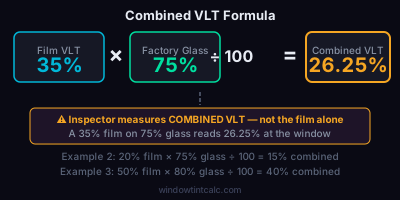
VLT (Visible Light Transmission) is the % of light that passes through your window. A 35% film on 75% factory glass gives you 26.25% combined, not 35%.
Quick Answer: VLT stands for Visible Light Transmission, the percentage of visible light that passes through your window. A 20% VLT window blocks 80% of light. The critical thing most people miss: the film's labeled VLT percentage is not what gets measured at inspection. The combined VLT (film × factory glass ÷ 100) is what matters.
Most tinting confusion comes from one simple misunderstanding: people think the number on the film package is the number that matters at inspection. It isn't. Understanding why, and what number actually matters, takes about 5 minutes and saves you from failed inspections and wasted money.
What VLT Actually Measures
VLT stands for Visible Light Transmission. It's expressed as a percentage, representing the fraction of visible light that passes through the glass from outside to inside.
- 70% VLT: 70% of light passes through. Very light, barely noticeable tint.
- 35% VLT: 35% of light passes through. Noticeably darker, visible privacy effect.
- 20% VLT: 20% of light passes through. Dark, significant privacy.
- 5% VLT: 5% of light passes through. "Limo tint", nearly opaque.
The lower the number, the darker the window.
This is measured by shining a standardized light source through the glass and measuring what percentage reaches the other side. The device used is called a tintmeter (or tint meter). Law enforcement and inspection stations use these. They clip onto the glass edge and take a reading in about 2 seconds.
Why the Film Percentage ≠ What Gets Measured
Here's the piece that surprises almost everyone: your car's factory glass already has a VLT. It's not 100% clear. Factory side windows typically run 70-80% VLT. Some factory rear glass runs as low as 65%.
When you install a film, the light has to pass through both layers, the factory glass and the film. The combined transmission is the product of both, not the average.
The formula is:
Combined VLT = (Film VLT × Factory Glass VLT) ÷ 100
This isn't an approximation. It's straightforward optics: if the glass lets through 75% of light and the film lets through 35% of what reaches it, the combined result is 35% of 75% = 26.25%.
Two Worked Examples
Example 1: 20% film on typical sedan glass
Say your factory side windows measure 75% VLT (common for most sedans). You install a 20% film.
Combined VLT = (20 × 75) ÷ 100 = 15%
The tintmeter reads 15%, not 20%. If your state requires a minimum of 20% (like Georgia for rear side windows), you just failed. And you'd have no idea unless you ran the math first.
Example 2: 35% film on slightly darker factory glass
Some cars, particularly certain Japanese and European models, have factory glass closer to 80% VLT. You install a 35% film.
Combined VLT = (35 × 80) ÷ 100 = 28%
That's very different from the result you'd get on a car with 70% factory glass:
Combined VLT = (35 × 70) ÷ 100 = 24.5%
Same film. Different cars. Different legal outcomes if you're in a state with a 28% minimum.
This is why our window tint VLT calculator asks for your factory glass VLT, it's the variable that makes the single biggest difference in your actual measured result.
How to Find Your Factory Glass VLT
You have three options:
1. Ask your installer: Any reputable shop will meter your bare glass (an untinted window or the untinted part of the windshield) before the install. This takes 30 seconds.
2. Check your owner's manual: Some manufacturers list the glass VLT specification. Not all do, but it's worth checking.
3. Use typical values as an estimate: Most sedans and coupes: 70-75% factory side glass. Most SUVs and crossovers: 70-80%. Factory rear windshield: 65-75%. These are estimates, your actual car may differ.
For precise calculations, getting an actual meter reading is worth the 2 minutes.
Working Backwards: What Film Do You Need?
The more useful calculation is the reverse: given your state's legal minimum, what film VLT do you need?
Required Film VLT = (Legal Minimum ÷ Factory Glass VLT) × 100
Example: Nevada requires 35% minimum on front windows. Your factory glass is 75% VLT.
Required Film VLT = (35 ÷ 75) × 100 = 46.7%
You need a film labeled at least 47% (rounding up for margin). If you buy 35% film assuming it meets the 35% limit, you'll actually measure 26.25% and fail inspection.
The tint percentage calculator does both calculations automatically, forward (what will my combined VLT be?) and backward (what film do I need to hit a target?).
VLT vs. TSER vs. IR Rejection
These three metrics get confused constantly, but they measure completely different things:
VLT (Visible Light Transmission): What percentage of visible light passes through. This is what tint laws regulate. It's measured with a tintmeter.
TSER (Total Solar Energy Rejection): What percentage of total solar energy (UV + visible + infrared) is blocked by the film. This is the heat rejection metric. A 35% VLT ceramic film might have 60% TSER, meaning it's blocking 60% of solar heat while still letting 35% of visible light through. TSER is not regulated and is not measured at inspection.
IR Rejection (Infrared Rejection): What percentage of infrared radiation specifically is blocked. Infrared is the primary heat-carrying component of sunlight. High IR rejection = good heat blocking. Ceramic films achieve 95%+ IR rejection at some wavelengths.
You can buy a window film that looks nearly transparent (70% VLT) but blocks over 50% of the heat coming through. This is the whole case for light-colored ceramic films in strict states like California and New York, you stay legal at 70% VLT while still getting meaningful heat protection.
What the Tintmeter Actually Reads
A tintmeter measures the combined VLT of everything between the two sensors, the glass and any film on it. It doesn't distinguish between the factory glass contribution and the film contribution. It just reads the total.
This means:
- If you have 70% factory glass and install a clear UV-blocking film (say, 90% VLT), your tintmeter reads (90 × 70) ÷ 100 = 63%. Still legal in strict states, but already measurably different from stock.
- If someone adds a clear protective film (like paint protection film extended to windows), that also reduces VLT slightly.
- Scratched, dirty, or aged glass changes the reading. An old, hazy window might read lower than a new clear one with the same tint.
Common Confusion Points
"I bought 35% tint. Why did I fail the 35% inspection?"
Because your factory glass isn't 100%. A 35% film on 75% glass gives you 26.25% combined.
"The shop told me 20% was legal in my state."
They might be right if your state's limit is 20% and they're accounting for factory glass in the calculation. Or they might be saying the film is 20% and not thinking about combined VLT. Ask them: "What will the tintmeter actually read on my car?"
"My car has factory tinted rear glass, does that matter?"
Yes. Factory privacy glass on rear windows is often 15-25% VLT. If you apply a 35% film on 20% factory glass: (35 × 20) ÷ 100 = 7%. That's very dark. Some states have no restriction on rear glass, making this fine legally. Others (like New York) restrict rear glass to 70%, in which case you can't add any film at all.
Before You Buy Film
The single most important thing you can do before ordering film or scheduling an install is run the calculation with your car's actual factory glass VLT. Use our window tint percentage calculator, enter your factory glass VLT and the film VLT you're considering, and confirm the combined result meets your state's minimum.
Then check your state's actual legal limit. For a full breakdown of requirements by state, our window tint laws guide covers the major states with front side, rear side, and rear windshield limits.
And if you've already got tint and you're not sure where it falls, our guide to measuring VLT at home walks through three methods for getting an accurate reading without expensive equipment.