How to Measure Your Window Tint VLT at Home
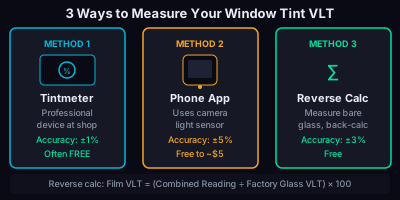
Three methods to measure window tint VLT: professional tintmeter (±1%, often free), smartphone app (±5%), or reverse calculation using factory glass VLT.
Quick Answer: The most accurate way to measure your window tint VLT is a professional tintmeter, most tint shops will do it free in 2 minutes. Smartphone apps work within ±5%. For the reverse calculation method, you need your factory glass VLT and your combined window reading: Film VLT = (Combined ÷ Factory Glass) × 100.
You bought a used car and you're not sure if the previous owner's tint is legal. Or you got a tint job and you want to verify the shop installed what they said. Or you're in a new state with different laws and you need to know if your current windows will pass.
All three scenarios have the same solution: measure the VLT. Here's how.
Why You'd Need to Measure
Most people who measure tint fall into one of these situations:
Bought a used car with existing tint: You have no idea what VLT it is, who installed it, or whether it was legal in its previous state. You need a number before you drive through a state with strict enforcement.
Moving to a new state: Your 20% rear tint that was perfectly legal in Texas might cause problems in New York (70% minimum on all windows). Knowing your current VLT tells you whether you need to change anything.
Verifying an install: A shop told you they installed 35% ceramic. You want to verify that's actually what you got, not something darker that would fail inspection.
Selling the car: Buyers in some markets specifically ask about tint. Being able to document the VLT adds credibility.
Method 1: Professional Tintmeter (Most Accurate)
A tintmeter is a calibrated optical device that measures VLT with ±1% accuracy. It has two arms, one on the inside of the glass, one on the outside. It emits a standardized light beam and measures how much gets through.
Where to get this done:
- Any window tint shop, most will do a quick measurement for free as a courtesy. A reading on all four side windows takes less than 5 minutes.
- Some state DMV inspection stations have tintmeters and will check your windows during a safety inspection.
- Auto parts stores occasionally have them at the service desk.
- Police traffic stops, officers in many states carry handheld tintmeters and can measure during a stop.
What the reading tells you: This measures your actual combined VLT, the glass plus any film together. This is the same number an inspection station or officer would record. If you need to know the film VLT specifically (to understand what film was installed), you'll need to know your factory glass VLT to work backwards.
Accuracy: ±1% when the device is properly calibrated and the glass is clean. Temperature and tinting condition of the device affect results slightly, which is why different meters on the same window sometimes vary by 1-2%.
The tintmeter method is the right choice whenever you need a legally defensible measurement or you want to know exactly where you stand before an inspection.
Method 2: Smartphone App
Smartphone apps that measure VLT have gotten more useful in recent years, though they're still not as accurate as a proper tintmeter.
How they work: Most apps use your phone's camera or light sensor to compare ambient light levels, light readings through an untinted reference area versus through the tinted glass. Some apps use a two-phone approach: one phone shines a bright light on one side, and the other measures how much comes through.
Accuracy: Expect ±3-8% depending on the app, your phone's sensor quality, and lighting conditions. On a clear, sunny day with consistent lighting, good apps get within 5% of a tintmeter reading. In inconsistent light (cloudy day, indoor fluorescent lighting), accuracy drops.
How to use them effectively:
1. Find an overcast day or shade, direct sunlight variations between readings throw off results
2. Measure 3-4 times and average the results
3. Compare to an untinted reference window in the same lighting conditions
4. Don't rely on a single reading
Best for: Getting a rough sense of where your windows fall when you don't have access to a tintmeter. If the app says 22% and your state's limit is 35%, you're very likely in violation. If it says 38% and your limit is 35%, it's close enough that you should get a professional reading to be sure.
Apps aren't appropriate for legal disputes or official documentation, but they're genuinely useful for a quick ballpark.
Method 3: Reverse Calculation
This is the most interesting method and the one that gives you film-specific information rather than just a combined reading. It requires two measurements and some arithmetic.
What you need:
1. The combined VLT of the tinted window (either from a tintmeter or app reading)
2. The VLT of your factory glass alone (measured on an untinted window on the same car)
The formula:
Film VLT = (Combined Window Reading ÷ Factory Glass VLT) × 100
Worked example: You read your tinted driver's window at 20% combined on a tintmeter. Then you measure the rear windshield of the same car, it has no aftermarket film, just factory glass, and get a reading of 75%.
Film VLT = (20 ÷ 75) × 100 = 26.7%
The film installed on your windows is approximately 26-27% VLT. That's close to a 25% film, which makes sense as a common product.
Why this is useful: It tells you exactly what film was installed, useful if you're buying a used car and want to know whether the dark rear tint is 20% or 35%. It also tells you whether the shop installed what they quoted.
Accuracy: The reverse calculation is only as accurate as your input measurements. If your combined reading has ±3% error and your factory glass reading has ±2% error, your film VLT estimate has ±5-6% error. Good enough for practical purposes, not good enough for official documentation.
Step-by-step process:
1. Find a window on your car with no aftermarket film. For most cars, this is the windshield (factory glass only, above the AS-1 line) or a front door window on a car where only the rear was tinted.
2. Use your tintmeter or app to measure the bare factory glass. Write down this number.
3. Measure the tinted window you want to evaluate.
4. Apply the formula: (Tinted reading ÷ Factory glass reading) × 100 = Film VLT
You can also run this through our window tint VLT calculator, enter your combined VLT and factory glass VLT, and it reverses the calculation for you automatically.
Comparing Your Results to Legal Limits
Once you have your combined VLT measurement, comparing to your state's legal limit is straightforward.
The critical nuance: state laws specify the minimum combined VLT at the window, the same number your tintmeter reads. So your measured number goes directly into the comparison.
For example, Nevada requires 35% minimum on front side windows. If your tintmeter reads 32% on your front windows, you're over the limit by 3 percentage points. If it reads 38%, you're legal with a 3-point margin.
For a complete list of legal limits by state and window position, our window tint laws by state guide has front side, rear side, and rear windshield requirements for major states.
If your measurements show you're over the limit, use our tint percentage calculator to determine what film VLT you'd need to reach compliance. The reverse formula in step 3 above will also confirm what film is currently on the car.
Accuracy Limitations to Know
A few things affect measurement accuracy regardless of method:
Glass temperature: Cold glass transmits light slightly differently than warm glass. Measurements on a winter morning vs. a summer afternoon can vary by 1-2%. This is within the accuracy range of most readings but worth knowing.
Glass cleanliness: Haze, water spots, or road film on either side of the glass reduce VLT readings. Clean the glass before measuring.
Aging film: Old dyed film that has partially faded may read differently (higher VLT) than when new, because the dye has broken down. Carbon and ceramic don't have this issue.
Multiple film layers: If someone installed film on top of existing film (which happens), your reverse calculation becomes complicated. Multiple layers don't multiply simply in practice due to optical interference effects.
Using the Calculator for Your Specific Situation
Whether you're verifying an existing install, shopping for new film, or trying to figure out what combined VLT your planned film will produce, the window tint percentage tool handles all three scenarios:
- Forward calculation: Enter film VLT + factory glass VLT → get combined VLT
- Reverse calculation: Enter combined VLT + factory glass VLT → get film VLT
- Target calculation: Enter desired combined VLT + factory glass VLT → get required film VLT
For a deeper understanding of how these calculations work and what the numbers actually mean, our VLT explained guide covers the formula in detail with multiple examples.